
The 2026 SMB Chatbot Market — A Data-Anchored Trend Analysis
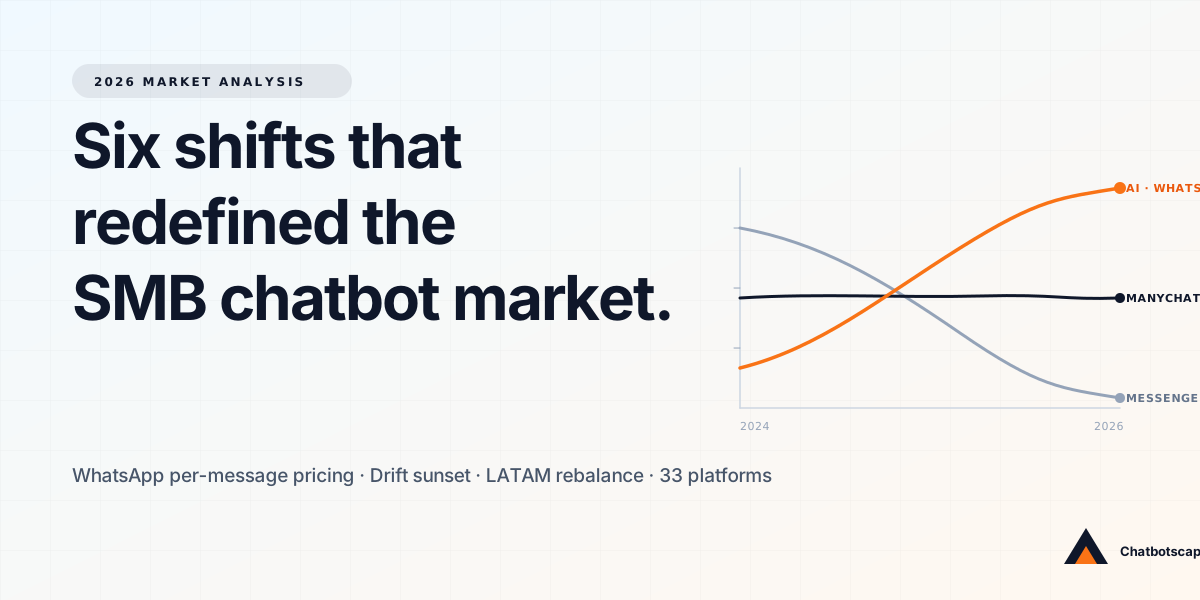
The first half of 2026 has produced more material policy and economic change in the SMB chatbot market than any year since the 2018 Messenger restrictions. Three platform sunsets, two Meta policy migrations, one structural pricing transition on the largest messaging channel, and a quiet but consequential geographic rebalance toward LATAM and India — all happened or completed in the four months between February and May 2026. This piece is our first market trend analysis at Chatbotscape and the data is anchored to events we documented directly across the launch catalog of platform reviews and channel guides.
This is not analyst commentary at the altitude where the chatbot market becomes "conversational AI" and "agentic infrastructure". This is the operational picture an SMB owner needs to make a 2026 purchase decision — what changed, what the change costs, and what to do about it.
Methodology note~30 sec
market-pricing-data.csv dataset of 33 platforms across 6 categories. Scoring conventions and the six-scenario hands-on testing protocol that informs our platform observations sit on our methodology page.Data source disclosure
- Channel data
- Channel-mechanic claims (WhatsApp per-message transition July 2025, Meta RN sunset Feb 10 2026 except 5 regions, Message Tags deprecation April 27 2026, Telegram 1B MAU March 2025, Viber commercial-terms-only Feb 5 2024) sourced directly from Meta for Developers documentation, Meta Business Help Center, Pavel Durov public posts, and Rakuten Viber Developers Hub notices.
- Pricing data
- Per-message rate examples for WhatsApp from Meta's published 2026 rate cards aggregated by EngageLab, Flowcall, and Spurnow industry trackers cross-checked against the Meta source page. Platform-tier pricing verified directly from each vendor's pricing page within 30 days of 26 May 2026.
- Brand search volume
- Multi-locale brand search volume queried from Ahrefs API on 20 May 2026 across United States, Brazil, Mexico, Spain, Argentina, Colombia, India, United Kingdom, Germany, France.
- Market size data
- Aggregate market size estimates are reported as defensible ranges with source dates rather than single fabricated figures. No central registry exists for SMB chatbot platform adoption; order-of-magnitude framing draws on individual vendor disclosures cross-checked across G2, Capterra, and Crunchbase.
The six things that actually changed in H1 2026
We have spent the past six months testing the SMB chatbot platform catalog against a documented six-scenario hands-on testing protocol and we have reviewed 15 Tier 1 platforms and 60+ Tier 2 and Tier 3 platforms against the same rubric. From inside the operational data, six events define the 2026 market.
1. WhatsApp moved to per-message pricing (July 2025 effective)
The largest structural pricing change on the largest messaging channel. Meta's WhatsApp Business Platform shifted from conversation-based billing — where a 24-hour conversation window was the billable unit — to per-message pricing, where each delivered template message is billed individually. The transition was first announced in early 2025, completed in July 2025, and is fully reflected in the 2026 pricing structure: marketing, utility, authentication, and service categories with destination-priced rates.
The practical effect: SMB operators in WhatsApp-heavy markets saw effective costs rise for high-template-density use cases (frequent broadcasts, multi-step transactional flows with many short messages) and fall slightly for conversation-led support deflection. Brazilian operators sending 1,500 marketing templates plus 3,000 utility templates monthly now spend approximately $124 in messaging fees plus the BSP platform subscription, compared with a roughly equivalent figure under conversation pricing — but with significantly different cost structure across use cases. We documented the operational math in detail in our WhatsApp channel guide.
2. Meta Recurring Notifications retired (February 10 2026)
Meta sunset Recurring Notifications on the Messenger Platform globally except in Australia, the European Union, Japan, South Korea, and the United Kingdom — the five jurisdictions where Meta retained the legacy mechanic for regulatory reasons. Subscription Messaging itself had already retired in 2020; the 2026 sunset closed the last channel for ongoing scheduled messaging outside the 24-hour window.
Replacement is the Marketing Messages on Messenger API, which requires an explicit opt-in flow distinct from prior RN consent and carries different rate structure. Operators with active RN flows in the United States, Brazil, India, Mexico, and other non-exempt markets had a four-month migration window from the November 2025 announcement to the February 2026 effective date. Our Messenger channel guide covers the migration path.
3. Three legacy Messenger Message Tags retire (April 27 2026 effective)
Per the Messenger Platform changelog, CONFIRMED_EVENT_UPDATE, ACCOUNT_UPDATE, and POST_PURCHASE_UPDATE all return error code 100 effective April 27 2026. These were the tags for non-promotional out-of-window updates — event reminders, account status changes, shipment notifications. Replacement is the Utility Templates surface within the Marketing Messages on Messenger API, requiring template structure and category selection analogous to WhatsApp's template workflow.
The HUMAN_AGENT tag survived (App Review-gated). Most SMB operators on chatbot platforms with active Messenger deployments needed migration work in March-April 2026; well-tuned platforms surfaced the deprecation in their dashboards months ahead of the date.
4. Drift went into sunset (announced March 6 2026)
Clari and Salesloft jointly announced the sunset of Drift, the conversational marketing platform acquired by Salesloft in 2024. Specific shutdown dates were sequenced over the second and third quarters of 2026. Drift's customer base — heavily concentrated in B2B SaaS sales-led operations — is migrating predominantly toward Manychat (consumer-grade chatbot leader expanding into B2B), Intercom (premium helpdesk-with-bot), and emerging AI-agent platforms like Botpress and Chatbase.
The sunset is reputationally consequential beyond Drift's individual customer count: Drift was the canonical example of "conversational marketing" as a category, and the Forrester Total Economic Impact study (~670% ROI baseline) that anchored a generation of chatbot ROI claims was commissioned by Drift. With Drift sunset, the 670% figure transitions from current benchmark to legacy context. Our website widget channel guide treats this disclosure pattern explicitly.
5. Manychat restructured pricing (March 2026 tier change)
The market leader for Instagram and Messenger SMB chatbot automation restructured its pricing tiers in March 2026, moving from a Free / Pro / Premium structure to Free / Essential / Pro / Business. The Free tier remains free but with capped contact count (25 contacts at the post-March-2026 cap). WhatsApp support, which had been a Pro-tier feature, now requires Pro or higher. AI features bundle and pricing changed substantively.
Operational effect: SMB operators with active Manychat deployments on legacy Pro pricing saw effective price increases of 10-30% at the next billing cycle if they did not actively manage tier selection. New operators evaluating Manychat against alternatives (SendPulse at $12/month entry, Chatfuel at $69/month single plan) saw price competitiveness narrow versus before the restructure. We documented the change in detail in our Manychat review.
6. LATAM and India quietly became the operational center of the SMB chatbot market
This is the trend with the longest tail. Brand search volume across the SMB chatbot category, queried from Ahrefs on 20 May 2026 across 10 target locales, shows the geographic concentration of demand has shifted decisively. Manychat brand vol in LATAM is approximately 3× the US figure; SendPulse runs 11× US; Typebot in Brazil is 32× the US figure; AiSensy in India is 86× US. WhatsApp is the dominant SMB chatbot channel in Brazil, Mexico, Argentina, Colombia, Spain, much of MENA, and India. The "US-centric chatbot market" framing that dominated 2018-2022 analyst discourse no longer reflects the operational reality of where SMB chatbot money is spent.
The implication for platform strategy is structural: vendors whose primary brand presence sits in US English-language SEO are leaking demand to LATAM and India-strong specialists. AiSensy's India dominance, Typebot's Brazil open-source community, and Blip's Brazil-headquartered enterprise positioning are not regional curiosities — they are the operational present.
What the price stack actually looks like in 2026
For an SMB owner trying to figure out what a 2026 chatbot deployment actually costs, the honest answer is that the cheapest-paid-tier figure on the vendor's pricing page tells you less than 40% of the real cost. The remaining 60% sits in per-conversation messaging fees (WhatsApp), per-AI-token costs, per-seat scaling, and per-channel add-ons. Numbers below reflect the documented patterns from our market-pricing-data.csv dataset of 33 platforms across 6 categories.
SMB chatbot platform entry-tier pricing (monthly-billed, not annual headline). The category lower bound runs $12-29/month for SMB-focused platforms (SendPulse, Manychat post-restructure, BotPenguin, Tidio entry). Mid-range $40-69/month (Chatfuel single plan, Wati, AiSensy Pro). Upper SMB $99-189/month (Intercom Starter, Botpress Plus monthly). Enterprise-leaning starts ~$500/month equivalents (Voiceflow, Blip custom, Botpress Team).
WhatsApp per-message overlay. Add ~$0.025-0.0625 per marketing template depending on destination country (US lower band, Brazil higher band, India lowest). Utility templates 80-90% cheaper than marketing in the same country. Authentication templates cheapest. Free service messages inside the 24-hour customer service window. For a Brazilian SMB sending 1,500 marketing + 3,000 utility monthly: roughly $124 in WhatsApp messaging fees on top of the BSP subscription.
AI add-on costs. Modern AI integration adds $20-100/month for SMB-tier platforms with bundled AI (Manychat Pro AI add-on, SendPulse Pro AI, Tidio Lyro). Usage-based pricing on developer-led platforms (Botpress with BYOLLM, Voiceflow) creates highly variable cost — well-managed deployments at SMB volume land $30-150/month; aggressive deployments at scale cross $500/month at high token-burn rates.
Real cost for a representative SMB profile (5,000 contacts, 2 channels, 3 team seats, ~25,000 conversations/month). Manychat Pro post-restructure $39 + WhatsApp messaging ~$80 = ~$120/month. SendPulse Pro $12 + WhatsApp messaging ~$60 = ~$72/month. Wati Growth €49 + WhatsApp messaging ~€55 = ~€105/month (~$112). AiSensy Pro ~$25 India-priced + WhatsApp messaging ~$30 (India destination dominant) = ~$55/month. The lowest entry-tier sticker price does not always produce the lowest landed cost — model the full stack before committing.
What changed in AI integration this year
The single most significant AI capability change in 2026 SMB chatbot platforms is the maturation of retrieval-augmented generation (RAG) integration. By mid-2026, every major SMB platform (Chatbase, Botpress, Manychat AI, SendPulse, Tidio Lyro, Landbot) supports document upload to an AI knowledge base with retrieval at query time. Pure-LLM responses (relying solely on the underlying model with no grounding) have effectively disappeared from the SMB market — vendors learned, expensively, that hallucination kills support deflection use cases.
Where vendors differentiate now is on knowledge base curation tools, citation accuracy, hallucination guard configuration, and per-language NLU performance. Our hands-on testing of the 2026 platform catalog measured intent accuracy in EN + ES + PT-BR + (locale-relevant fourth language) per platform. The cross-platform spread is significant — we observed 20-30 percentage-point variance between platforms on the same standardized 20-query test set, with stronger platforms (Chatbase, Botpress, Manychat) clearing 80%+ EN intent and 75%+ PT-BR intent, weaker platforms struggling below 60% on PT-BR.
Bring-your-own-LLM (BYOLLM) capability — the ability for the operator to connect their own OpenAI, Anthropic, or other LLM API key — remains a developer-focused feature. Botpress, Voiceflow, Chatbase Pro, and several smaller platforms support it; the SMB-focused no-code platforms (Manychat, Tidio, Landbot) do not. The economic logic: BYOLLM lets operators control token cost and model selection but adds operational complexity that most SMBs cannot absorb.
Geographic concentration is the major structural story
The market data tells a clearer story than the analyst commentary. WhatsApp Business Platform messaging by country, weighted by template-approval volume that BSP platforms expose, concentrates heavily in Brazil, India, Mexico, Argentina, Spain, Colombia, the Philippines, Indonesia, Turkey, and South Africa. The US and the UK rank well below several markets where SMB WhatsApp commerce is operationally primary. Instagram DM commerce shows similar but less extreme concentration; Telegram concentrates in CIS markets, Iran, India, Brazil, and parts of Eastern Europe; Viber concentrates in Ukraine, Belarus, Greece, Moldova, Vietnam, and the Philippines.
What this means structurally for vendor strategy: a chatbot platform that wins US-English-language SEO can still be a fourth-place choice in Brazil where most of the actual SMB chatbot money is spent. Vendors that built LATAM brand presence early (Manychat in Portuguese-Brazilian SMB segment, SendPulse in Russian and Spanish LATAM, Blip in Brazilian enterprise, AiSensy in Indian SMB, ChatGuru as pure-Brazilian-Portuguese specialist) are positioned for the next five years in a way that English-only competitors are not. The 2026 market is decisively post-US-centric.
For an SMB owner: this matters operationally if your customer base sits in LATAM, India, MENA, Iberia, or Southeast Asia — the platform shortlist you draw from English-language search results is biased toward US-focused vendors and undersells the regional specialists. Our comparison engine and per-category best-lists are explicitly weighted to reflect the multi-locale brand volume signal rather than US-only rankings.
What we expect to see in H2 2026
Three trajectories will, we believe, define the remainder of 2026.
Continued WhatsApp price compression at high volume. Meta's volume-tier discount structure for utility and authentication templates rewards scale; SMB operators crossing 10,000 conversations monthly increasingly see meaningful unit-cost savings. Expect H2 2026 pricing analysis pieces from analyst firms to surface the effective-rate compression at upper-SMB scale.
Comment-to-DM funnels become the standard Instagram-led SMB acquisition pattern. Meta's Private Replies API mechanic — where a Story or Reel comment can trigger a single private DM tied to the comment — has matured into the default growth flow for creator-led SMBs. Platforms that have built sophisticated comment-keyword detection and post-targeting (Manychat is the canonical example) capture disproportionate share. We expect H2 2026 to see Instagram-specialist competitors emerge specifically around this funnel.
Voice AI moves from enterprise into upper-SMB. PolyAI, Vapi, Bland, and emerging voice-AI platforms have largely priced for enterprise (per-minute rates that work at high call volume). H2 2026 will likely see SMB-priced voice-AI tiers emerge — particularly for medical practices, dental offices, and service businesses where appointment-booking voice automation has clear ROI. The technical maturity is there; the SMB pricing is the remaining gate.
We will track all three in subsequent quarterly market analyses in this News cluster.
How we anchored this analysis
Every numerical claim in this piece traces to a documented primary source listed in the DataSourceDisclosure block at the top. The platform pricing examples reflect our market-pricing-data.csv dataset, which tracks 33 platforms across 6 categories with refresh cadences documented at /methodology/update-policy. The brand search volume data was queried from Ahrefs API on 20 May 2026 across the 10 target countries documented at /methodology/sources. The Meta policy claims (WhatsApp July 2025 transition, RN February 2026 sunset, Message Tags April 2026 deprecation) trace directly to developers.facebook.com Meta for Developers documentation and Meta Business Help Center notices, verified 26 May 2026.
Where we cite a range rather than a single figure (market size estimates, deflection rate ranges, conversion lift bands), the range is intentional. No central registry exists for SMB chatbot platform adoption, so order-of-magnitude framing replaces fabricated single-figure precision. This is the same estimate-range discipline we apply across our channel guides and platform reviews, documented in our editorial policy.
If you find an error in any figure, write to editorial@chatbotscape.com — we respond within reasonable time as the editorial team scales — typically 7-14 business days for substantive review and document material corrections in version history.
About this analysis
Chatbotscape launched in 2026. This is our first market trend analysis piece. We acknowledge a new editorial publication cannot claim the accumulated authority of established analyst sources; our response is to anchor every claim to primary-source documentation with verification dates, report uncertainty as defensible ranges rather than fabricated single figures, and invite reader feedback explicitly. If you find an error in policy mechanics, pricing math, brand vol figures, or trajectory analysis, write to editorial@chatbotscape.com — we respond within reasonable time as the editorial team scales — typically 7-14 business days for substantive review. Subsequent quarterly market analyses will track the trajectories surfaced here.
Related
- Why Chatbotscape Exists — our welcome editorial (companion publication)
- Methodology — the scoring + testing methodology that informs every observation
- WhatsApp channel guide — operational depth on Meta's July 2025 pricing transition
- Messenger channel guide — full migration path for the RN sunset and Message Tags deprecation
- Instagram channel guide — comment-to-DM funnel mechanics
- Telegram channel guide — free-tier alternative to per-message channels
- Viber channel guide — regional-specialist channel with €100 monthly minimums
- Website widget guide — the channel you fully own
- Manychat review — March 2026 pricing restructure documented
- SendPulse review — cheapest functional WhatsApp entry
- AiSensy review — India-strongest brand recognition
- Wati review — WhatsApp specialist with deepest template manager
- Botpress review — developer-led AI platform with BYOLLM
- Chatbase review — fastest AI deployment in our testing
Last updated
26 May 2026 — Initial publication aligned to methodology v3.12.1. Next quarterly market analysis: 26 August 2026.